
Joz Norris is a multi-award-winning comedian, writer and performer whose work spans stand-up, scripted comedy, acting, radio and film. He won the Comedians’ Choice Award for Best Show at the Edinburgh Fringe in 2019, and the Leicester Comedy Festival Award for Best Show in 2026.
He created and co-wrote the BBC Radio 4 sitcom The Dream Factory, starring alongside Stevie Martin, Desiree Burch, and Kiell Smith-Bynoe, and has appeared in a range of television and film projects alongside his live comedy work.
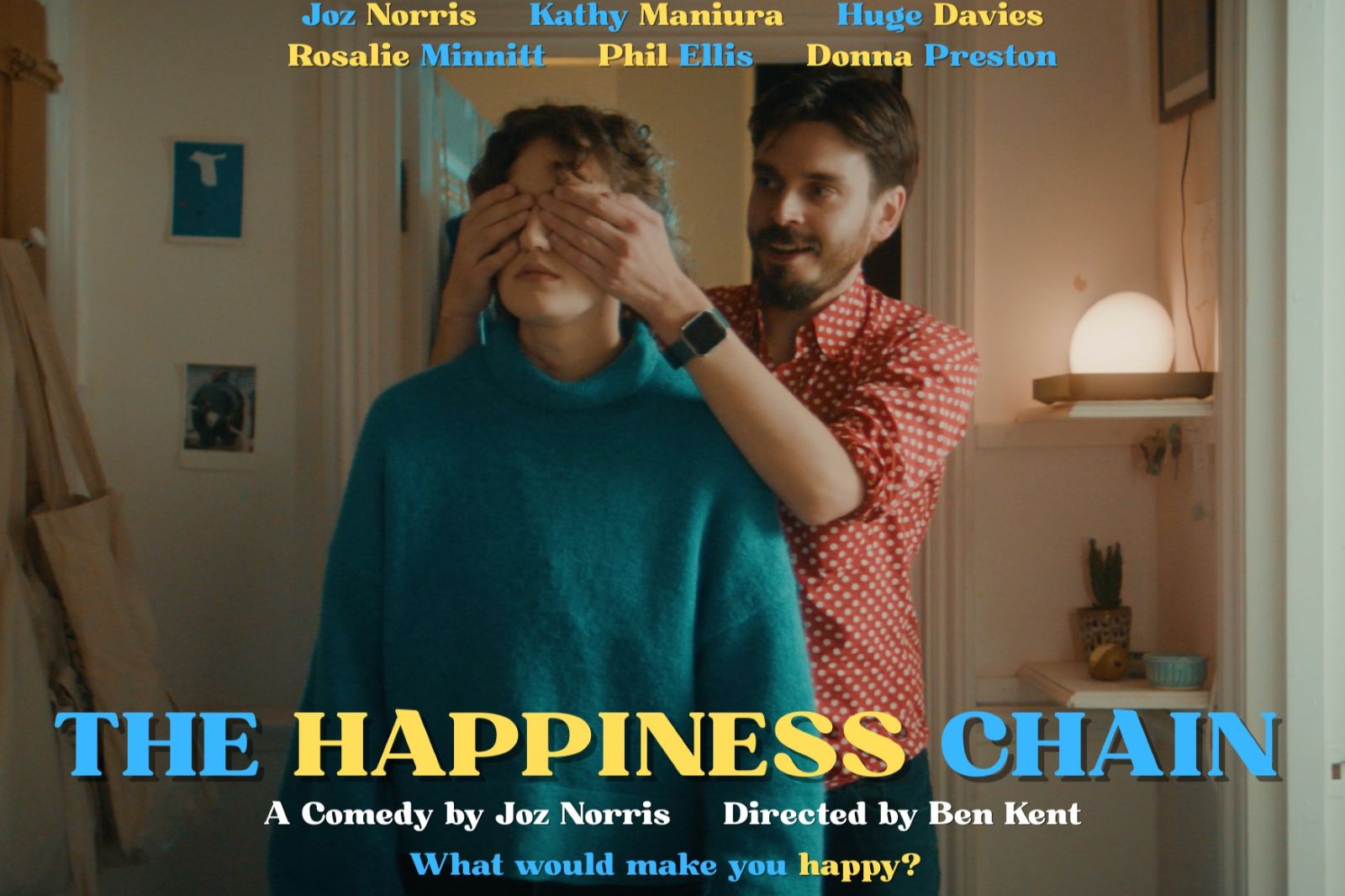
His lates project is Joz Norris is an independently-made sitcom pilot The Happiness Chain, about two friends whose lives suddenly go in opposite directions, and their elaborate attempts to find out what actually makes people happy. The pilot, starring Norris, alongside Kathy Maniura, Rosalie Minnitt, and Huge Davies, is being released on YouTube on Thu 5 Nov, preceded by three making-of documentaries in the weeks leading up to the release date. We spoke to Joz about the idea behind the show, making it independently, and the TV comedy industry as a whole.
Can you tell us about The Happiness Chain?
Basically, it was a project that I started writing as a TV script. But by the time I was starting it as a TV script, it was already an attempt to kind of salvage the story of a podcast that I’d spent a while trying to make that I couldn’t make sense of. It was this very convoluted idea about talking to somebody who has the one thing you think you need in order to be happy, and then finding out what they think they need, and then finding somebody who has that and interviewing them; and I always quite liked the shape of it, but it was just such a mess.
As I was trying to make it, I didn’t know what my reasons were in making it. I think it was like… I don’t know; I thought that by making it, it would give me permission to do something else, because it was all about kind of filling the gap that you think you have in in your life or whatever. So I think I was making it to try and teach myself that you don’t need to do that. Except weirdly, then I did get stuck in this pattern of trying to fill the gap with this podcast. It was a weird self-fulfilling prophecy, so I gave up on that and turned it into a TV script and put much more of a human story at the middle of it.
It was about characters we actually cared about, rather than about a podcast. In the finished pilot, the podcast is much less of the focus. It’s kind of an absurd project that one of the characters is trying to get away with because he thinks that it will solve his life. But it’s actually about these two friends who have always kind of been pursuing different things, and then suddenly their fortunes switch.
So one who has always been the kind of person to be thinking, ‘Oh, maybe if I do that, and maybe if I do that, then suddenly everything will click into place.’ That character, which is my character, suddenly gets a sponsor for a creative project. That means he’s suddenly secure, which he never has been before. And the other character who has always been like, ‘I’m just going to do my thing because I know what I want and I’m going to go and do it,’ she suddenly has her life kind of fall apart a little bit and is then like, ‘Oh, so now what do I do?’ So it’s sort of about those moments in life where you’ve been on one track and suddenly it shifts.
I wrote that as a script, and then I think weirdly it came back to a thing being about permission in a way, because I spent a couple of years trying to write TV development stuff, and you end up writing these scripts that a few dozen people see and really like, but then it doesn’t get across the line, and then it ends up being something that nobody ever gets to see it. So I think as a way of kind of drawing the line under it, it was really nice to just go, ‘Well, let’s see if we can raise some money and make it as a pilot by ourselves.’ Whether that means it goes anywhere and we get to make more of it or or not, it doesn’t really matter. We just sort of made it for for us, really.
That explains why you went down the independent route. How did director Ben Kent get to read it? Is there a sort of repository for TV scripts, like the Black List for films?
I was sort of putting it to one side, and then I submitted it… I think it was for the BBC Comedy Collective; I submitted it as my script for that, which is a sort of a bursary scheme. And I didn’t place on the collective, but the script got me placed in the top 5% or something. So that I think made me feel encouraged about it again. And I think I posted something about wanting to work out what to do with this script, but not really knowing what because I knew that it had kind of reached the end of its life going through proper TV channels. Ben replied to that and said, ‘Oh, I’ll have a look at it,’ and then read it and was like, ‘This is great, and you know, it’s relatively easy to film because it is just set in a few rooms. So why don’t we just do it?’
I feel we’re at an interesting time for scripted stuff where less stuff is getting made because there’s just not as much money in those kind of older infrastructures. And online is really big for some stuff, but it is hard to make scripted stuff online because it’s expensive. So I think the whole audience-funded model… with this pilot we crowd-funded, which was great, but we probably couldn’t crowd-fund a whole six-part series. So I think it’s this weird in-between stage where I think it’s worth experimenting with these things to find out whether there could be a home for slightly more high-effort scripted comedy as well.
Because it’s so easy to go out with your phone and film sketches and film podcasts. You know that’s exploding and that’s really great.But I hope that the pivot to online doesn’t mean that we lose proper narrative scripted stuff. So I think just trying to see whether [we could] make that independently with a small team was a really exciting experiment for me. But I don’t think I’ve solved the question because I don’t know when I could do that again. You need to leave a big enough gap before you go back to your audience to go, ‘Does anyone want some more of that?’ But certainly, it was a really cool learning thing.
You said the entire climate for TV comedies has shifted, and coincidentally Ben Wilbond from Ghosts said very much the same, which is why they went down the filmic route for its comeback. Do you think there is perhaps a kind of post-Fleabag malaise in TV comedy now at the moment?
Yeah, yeah, maybe a little bit. I remember seeing an amazing talk with Jamie Demetriou a couple of years ago at the BBC Comedy Festival, where he said because Fleabag still keeps being brought up – and we mentioned it in the chat I had with Ben [Kent] in the making-of thing that I’ve been doing – even though it was over a decade ago now, it still gets brought up as the thing that changed everything in comedy commissioning. And Jamie Demetriou said that the way you find the next Fleabag or the next Baby Reindeer or whatever it might be, is that you look for whoever is making the opposite of that, because you’re going to have so many people trying to imitate a hit, and actually hits come from people just authentically doing their thing and doing it for their reasons.
So, if you find somebody that, for whatever reason, is as far away from Fleabag or from the most recent popular thing as possible, then you’re probably going to find something really cool. I’m not saying that’s what this is. This was an attempt to sort of sit in the middle. I didn’t want to make something that was just in the mould of TV commissioning, but I also wanted to challenge myself to write something a bit more in the real world because a lot of my shows are very absurdist and big and high concept and stuff. So it was trying to take a little bit of what works in one space and a little bit of what works in another space. But I do think that there hasn’t been enough of TV actually empowering people to just make stuff, you know, and find out what’s a good expression of their voice and what’s an authentic version of the ideas and the stories that they want to tell.
Anyone who’s been keeping an eye on comedy for the last couple of years will know pretty much everybody that’s involved in the pilot. How did you assemble such a good cast?
It was just sort of an evolving conversation, really. When I was writing, I had them more in my head as characters than I did as actors, which doesn’t always happen. Sometimes I have a very clear voice in my head of, ‘Ideally, I’d love this to be so-and-so’, but with this one I was writing them much more as characters that were interacting in my head, so it meant that when it came to talking about the casting, I didn’t have too many fixed ideas of what it should be, which meant that some of them turned out exactly sort of the way I imagined. But other [characters], because I was very open to thinking about what anyone would do with it, we ended up with versions of it that were actually really surprising to me in a really fun way. Where I was like, ‘Oh, I kind of thought this would be that,’ and actually, it’s so much more interesting played that way. But they’re all just people I really like and admire, really.
Obviously, it’s a big ask to ask people to give up a couple of days of their time for not a huge amount of money, for something quite intense where it’s going to be long shooting days. So I wanted it to be people that I knew, so that I didn’t feel like, ‘Oh god, I’ve got this person here and I don’t really know them, and they’ve given up so much of their time!’ So, they’re friends, but they’re people whose work I love, and just trying to find that balance really of who going to make it the best thing possible, and who would be fun and cool to hang out with for a couple of days.
Was the script pretty much locked in, or was there room for improvising, given all the cast are really accomplished comedy writers themselves?
They’re amazing. The script was pretty locked in from quite early on. The purpose of the project was like, ‘Let’s film this script,’ because we really liked it and people had had nice feedback about it so we wanted to get it down. In another world, I would love to assemble the exact same cast together and make something that was much more improv-led, and that would be a whole different project in itself. There’s moments in there which are very much from the actors, particularly Phil Ellis and Donna Preston‘s characters. There are some moments in there where they were kind of written as chaos characters because they’ve got this one kind of big scene so we very much let them steer some of that.
But throughout the [pilot], there are things that each actor brings to it, little kind of asides or bits where they slightly put it into their own wording or weird little moments that are brilliant that really kind of surprised me. But yeah, something that was actually fully led by the performer’s own sensibilities would be amazing as well.
If we did get to do more of it; if there was a world where there is an audience on the internet that goes, ‘We really like this, we’ll chip in for some more cheaply-made episodes!’ or whatever, then that may well be some route I go down. Now that I know who the cast is, it means you can leave much more space to be like, ‘Kathy’s going to do something really cool with that, and Huge would do something really funny with this.’ So you can be a bit less prescriptive with it.
Making it independently, was there an opportunity to add material that you know probably wouldn’t get past a TV producer?
I guess in a way the whole thing was something that didn’t get past a TV producer because nobody commissioned it in the end! It’s definitely not a very dark story or a very extreme story. It was, again, a bit of a writing challenge to myself to try and write something fairly feel-good… so many of my shows are quite brash and aggressive. So I wanted to write something a bit more gentle, in a way.
The thing that we did stumble upon in making it independently was, we had this framing device that wasn’t in the original script. Because it’s about somebody trying to get a stupid podcast off the ground, we thought we were able to actually couch it in the language of online. So it starts and ends with extracts from this guy’s YouTube channel, where he’s trying to make this stupid, convoluted project, and then in between those things, we see the the narrative of what’s going on in his life with the people that he knows.
But that was a nice thing that we sort of found by accident in a way, where the process of having made it by ourselves made it go, ‘Wait, we could actually show this world a little bit more.’ So it sort of sits in online and then comes out of it and then goes back in in a way.
And how how long did it take to make the pilot and how was the filming process as as an experience?
It was so stressful because we had so little time. One of the things you get if there is big money behind it and the commissioner has paid for it, and you’ve got a production company doing all the scheduling and stuff, then you get the luxury of time because there’s enough money to pay for it all. So when you’re doing it all for cheap and for favours… we sort of had to film the whole thing in two days for like an 18-page script, which is mad. Everything was a big rush.
Then we had an extra pickup day where we filmed this YouTubey stuff, the stuff that we see at the beginning and the end. We did that separately a while later once we’d worked out that would be a good way to frame it. So the actual shoot was done across two weekends, but there was a good couple of months of pre-production and location scouting and working out exactly how we were going to film it and just really drilling the script. And then again the edit. That was a much longer thing where we kind of rediscovered various different versions of it in the edit, and there was no deadline to to rush for with that, so we were able to kind of let it be the right thing. But the actual shoot was was pretty condensed and high time pressured.
Did you shoot on location in a flat or did you have a a sound stage?
It was sort of a mix of like we got one flat that was very nice, which we paid for because again we wanted to kind of represent this idea that one person has been living a life that has meant that she’s able to live somewhere nice, and the other one is sort of struggling a little bit.
We paid for one fancy location, and then the rest we filmed in places that we we have access to through friends and things like that. The flat that was supposed to be the less good flat where the other character lives is actually a really beautiful flat. This friend of ours let us film there because he has a small corridor, so we were able to make the corridor look kind of pokey and small or whatever. But when we got there, we were like, ‘This is amazing! This is really nice.’ And we felt quite bad about being like, ‘Here’s where the shit one lives.’
But again, you can cheat it so much in camera angles and find one little room that looks sort of small or whatever. So yeah, it was a bit of a mix of going to places that we had access to through our networks with people, and then spending the money on the locations where we know that this one needs to feel a bit different or have kind of fancy things on the walls or whatever.
You state in your first video that the original idea for the podcast came during a difficult period of self-doubt for you in 2023. Would you say that thematically The Happiness Chain is about the idea of fulfillment, and the point at which ambition becomes neurosis?
I want to clarify when I said I didn’t have a very nice time in 2023, that wasn’t because it was a traumatic year or because something terrible happened. It was because I spent all year trying to make things happen and they didn’t, and that becomes very draining. I just finished some projects and then you think, ‘Now I’ll do some more stuff,’ and I just wasn’t inspired and had no ideas and wasn’t really making any money which is a huge kind of stress and self-esteem pressure. It was just a year where I was frustrated and annoyed with myself for not being able to work out what to do next and I think that took me out of life a little bit and stopped me from enjoying it properly.
When you constantly tell yourself that your life is going to be this accumulation of like, ‘And then I’ll move on to the next thing and the next thing.’ I think you are just building neurosis and obsession for yourself. So the idea for [the show] as a narrative story is very much about two people who kind of recognise that they’ve reached a crisis point in their life or a crunch point in their life, or just a moment of big change, and they sort of recognise that the way to deal with that is just to to live life more, you know, to be more present in it and do it with people.
So yeah, that’s sort of what it’s about. It’s an attempt to kind of be an antidote to that sort of obsessive thinking of achievement and building all the time, and instead just kind of be there.
The Happiness Chain is released on YouTube on Thu 5 Nov. The making-of documentary series is available to view now

Comments