
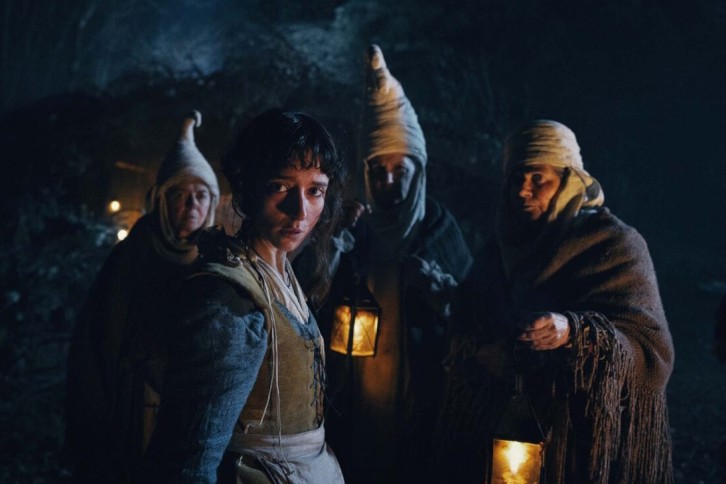
The work of Basque filmmaker Paul Urkijo Alijo tends to be most appreciated on the festival circuit, which is a shame. He has a startling, baroque visual sense and a keen understanding that fantasy and horror go hand in hand that should delight a wider audience with any fondness for the likes of del Toro, Terry Gilliam, or the wilder ’80s output of Jim Henson. His latest, Gaua (‘The Night’) is a full-blooded gothic folk tale that seethes with righteous anger against misogyny and the religious forces that embodied it in the early modern period.
Kattalin (Yune Nogueiras) is a young, very reluctant bride in a small village in northern Spain in the 17th century. After poisoning her husband beef wellington-style with some potent mushrooms, she flees into the dark forest. There, she’s followed by a sinister creature, and encounters three old women telling each other stories; stories that feel disturbingly familiar to the runaway bride.
Anyone who has seen the director’s previous work Errementari and Irati will know how beautiful Urkijo Alijo’s movies are, and Gaua is no exception. From the crepuscular lighting to the fabulous regional costumes, it’s gorgeous to look at. The cast revel in it, bringing a suitably earthy energy to their roles with the three older actors, Elena Irureta, Ane Gabarain, and Iñake Irastorza emodying this spirit particularly well. Somewhere between Macbeth‘s soothsayers and Terry Pratchett’s Wyrd Sisters, the act as richly entertaining guides through the woods for the viewer as much as Kattalin.
While entertaining throughout, Gaua is an occasionally choppy experience for a first-time watch, told in a non-linear fashion with threads nested within others. It undoubtedly comes into its own during a third act bacchanal that doubles as a reckoning for Kattalin. The rites depicted will be familiar to anyone familiar with the most rudimentary knowledge of the more sacriligious corners of heavy metal, or representations of Pan or Baphomet, following closely the rituals detailed in the charges laid out against the Eastern European Bogomils and the French Cathars by the Inquisition during the Albigensian Crusade.
However, even prior knowledge won’t prepare you for the glorious, surreal, wanton excess of Urkijo Alijo’s vision. It’s like Goya‘s most phantasmagorical paintings come to life; darkly surreal, pointendly satirical, gleefully sexual, and playfully seductive. It’s a scene of defiance, liberation, and community that also happens to include the most eye-popping incidences of zero-gravity nudity since Barbarella.
While not as coherent an experience as the extraordinary Irati, Gaua is the work of a filmmaker entirely in charge of his own vision. Paul Urkijo Alijo brings the mythology of his region to vivid life, revelling in both the darkness and light of the stories and leaving the viewer with imagery that will not soon be forgotten. If there’s any justice, wider appreciation will be forthcoming, but until then take any chance you can to track down his work.
Screened as part of Edinburgh Spanish Film Festival

Comments